


Part 13 of Chapter 1 in Chemistry
Some SI systems examples to show and more measurements used.
Service Description
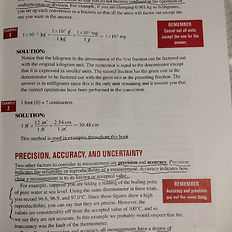
Grandma must cover it in depth for the Impaired. After using everything else about 1mL and cm to the 3rd as the same, the book brings up a figure of a cube to use for an example that as the figure shows, a 10 cm x 10 cm x 10 cm cube is called a liter. Since 1-liter 1000 cm to the 3rd, then 1 milliliter (mL) equals 1 cm to the 3rd. Since 10 cm equals 1 decimeter (dm), 1 liter is also equal to 1 cubic decimeter (dm to the 3). The book also states some interesting relationships between volume and mass units in the SI System. Since water is most dense at 4degreeC, the gram was intended to be 1 cm to the 3rd of water at this temperature. This means, then, that: 1000cm to the 3rd=1L of water at 4 degree C; 1000cm to the 3 of water weighs 1000g at 4 degree C. Therefore, 1L of water at 4 degree C weighs 1 kg and 1 mL of water at 4 degree C weighs 1 g. When 1 L is filled with water at 4 degree C, it has a mass of 1 kg. "Most units used by scientists are mathematical manipulations (derived units) of the seven basic units." The book has a Table that gives examples of commonly used derived units and the special names given to some of them as follows: Derived Units Quantity Derivation Unit Special Name density mass/volume g/mL velocity distance/time m/s acceleration velocity/time m/s to the 2nd force mass x acceleration kg - m/s to the 2nd newton energy force x distance kg-m to the 2nd joule We have seven more topics to look at from the book and Grandma will add them somewhere this week before the Chapter Practice questions and they will also be on the lessons for Monday. Grandma is not sure how she will add all the Chapters in the calendar yet. The designers from WIX may be able to help her.




Upcoming Sessions
Contact Details
304 S May Ave lot 32, Yuma, AZ, USA
9282872157
pamela72@grandmaslearning.com