


Part 3, Chapter 1, Algebra1
Continuation of property rules-discussing proof
Service Description
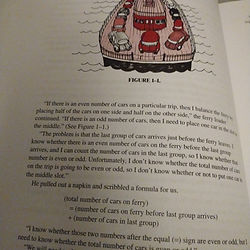
As part of Grandma's Place of Natural Learning The Royal Court of Carmorra were discussing proof of the 'commutative' property of addition, stating, "If you add any two numbers together, it doesn't matter in which order you add them. In Recordis naming 12 numbers he asked how many there actually were and the King said, "You can't list them all! It would take you forever to make a list of all of the numbers. There must be an infinite number of numbers--meaning that there is no limit to how many there are." ""That's correct," the professor said, since you can always add 1 to any number to produce a bigger number, you can never find the biggest possible number." We used a sideways 8, like this oo, to stand for infinity. "Itwould be very difficult to show that the order doesn't-make-a-difference property is true for all possible numbers," the king said. "This isn't fair!" Recordis protested. "You would need to find only 'one' example in which the property does not hold in order to disprove it. If you could find only 'one' single situation where (first number)+(second number) does not equal (second number)+(first number) then we would know for sure that the property does not hold for all pairs of numbers. On the other hand, it would take me forever to prove to you that it does hold true for al pairs of numbers." We puzzled over this problem for a while. We finally decided to take a break and have lunch at the hotel restaurant, where we happened to be joined by the chief ferry-boat loader from the ferry dock adjacent to the hotel. The ferry-boat loader explained that his job was quite tricky, since it was imperative that the ferry be perfectly balanced, or else it might tip over. "It all depends on whether I have an odd number of cars or an even number of cars, "the ferry loader said. ("What are odd and even numbers?" Recordis whispered to the professor. The record keeper tended to forget most things, so the professor quickly explained. "An even number is a number that can be split evenly in half, such as 2,4,6,8,10, and so on. An odd number is a number that can't be split in half, such as 1,3,5,7, and so on. They're easy to tell apart, because the last digit of an even number is always 2, 4,6,8, or 0, and the last digit of an odd number is always 1,3,5,7, or 9." (Grandma must stop here for a meeting, Read some more under the picture for this lesson. I will type more later.)

Upcoming Sessions
Contact Details
304 S May Ave lot 32, Yuma, AZ, USA
9282872157
pamela72@grandmaslearning.com